Where Language access and literacy come together

This online symposium brings together families and professionals committed to strengthening language and literacy outcomes for deaf, hard of hearing, and deafblind children.

Beginning May 1, 2026, participants will have year-long access to recorded sessions and two live keynote presentations designed to inspire, inform, and support meaningful practice.

Keynote Presentations

The ongoing literacy crisis in the United States has galvanized policymakers, with more than 40 states now mandating that instruction, assessment, and teacher preparation align with the Science of Reading. At the heart of this movement are five instructional essentials—phonemic awareness, phonics, vocabulary, fluency, and comprehension—that together form the foundation of effective reading instruction. Yet for teachers serving students who are Deaf or hard of hearing (DHH), translating these essentials into practice is far from straightforward.

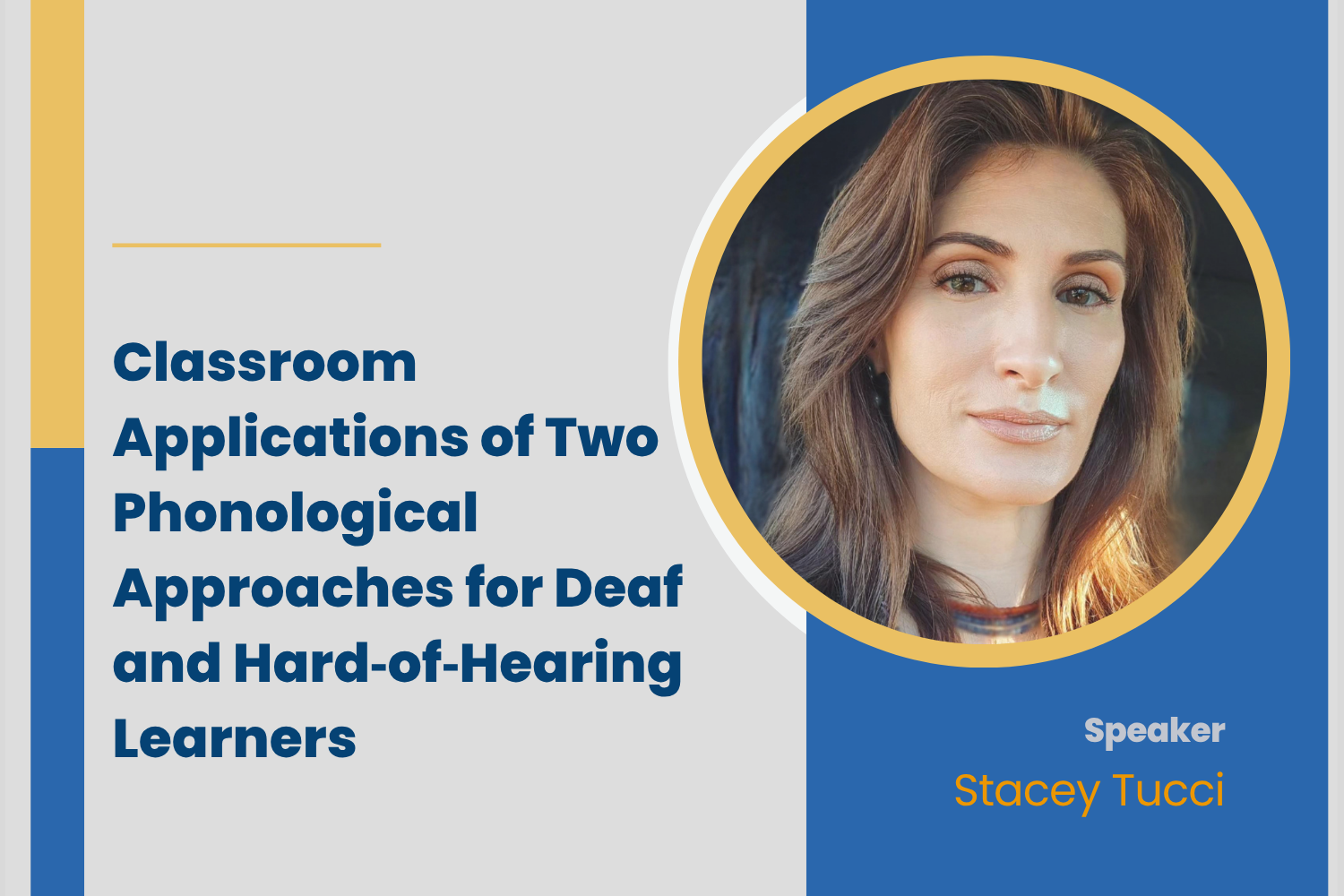
This session highlights findings from a recent study comparing two phonological approaches for three DHH learner profiles: Ears Only, Eyes and Ears, and Eyes Only. We will explore how Scarborough’s Reading Rope and the Bilingual (ASL–English) Reading Rope help illuminate the pathways to skilled reading for these learners. Participants will leave with practical, adaptable strategies for integrating sound‑based and fingerspelling‑based phonology across all DHH profiles.

Presenter Bio:

Dr. Stacey Tucci’s professional path is rooted in her experience as the parent of a Deaf daughter, a role that shaped both her commitment to and perspective on the field of Deaf Education. She began her career as a general‑education middle school mathematics teacher before transitioning into special education, where she taught elementary‑aged students who are Deaf or hard of hearing (DHH) across a wide range of communication modalities, including Spoken English, American Sign Language, and sign‑supported English.

Her academic preparation reflects this interdisciplinary foundation. Dr. Tucci earned her bachelor’s degrees in Early Childhood Education and Special Education, followed by a master’s degree in Deaf Education and a doctorate in the Education of Students with Exceptionalities from Georgia State University (GSU). Her doctoral research centered on intervention studies designed to improve outcomes for DHH learners. During her time at GSU, she served as a Research Associate on two federally funded Institute of Education Sciences (IES) grants, contributing to projects that advanced evidence‑based practices in the field.


Dr. Tucci’s scholarship includes peer‑reviewed journal articles, practitioner‑focused publications, and textbook chapters. She is the co‑author and training director of Foundations for Literacy, an evidence‑based early literacy curriculum for DHH students. Her commitment to professional learning has taken her across the United States and around the world, with invited presentations and seminars in Ethiopia, Australia, Taiwan, Greece, France, Canada, and the United Kingdom.

The national push toward Science of Reading–aligned instruction has reshaped literacy mandates across the United States. Rooted in research on phonological awareness, decoding, and sound-to-symbol mapping, these policies assume early and consistent access to spoken language. For many deaf and hard-of-hearing children, however, this assumption does not hold.

Without full access to the auditory stream, many deaf learners do not acquire language from birth in a natural, effortless way. Gaps in early language exposure profoundly affect later literacy development. Yet current mandates increasingly require deaf students to demonstrate proficiency using phonological systems that may never have been fully accessible to them.

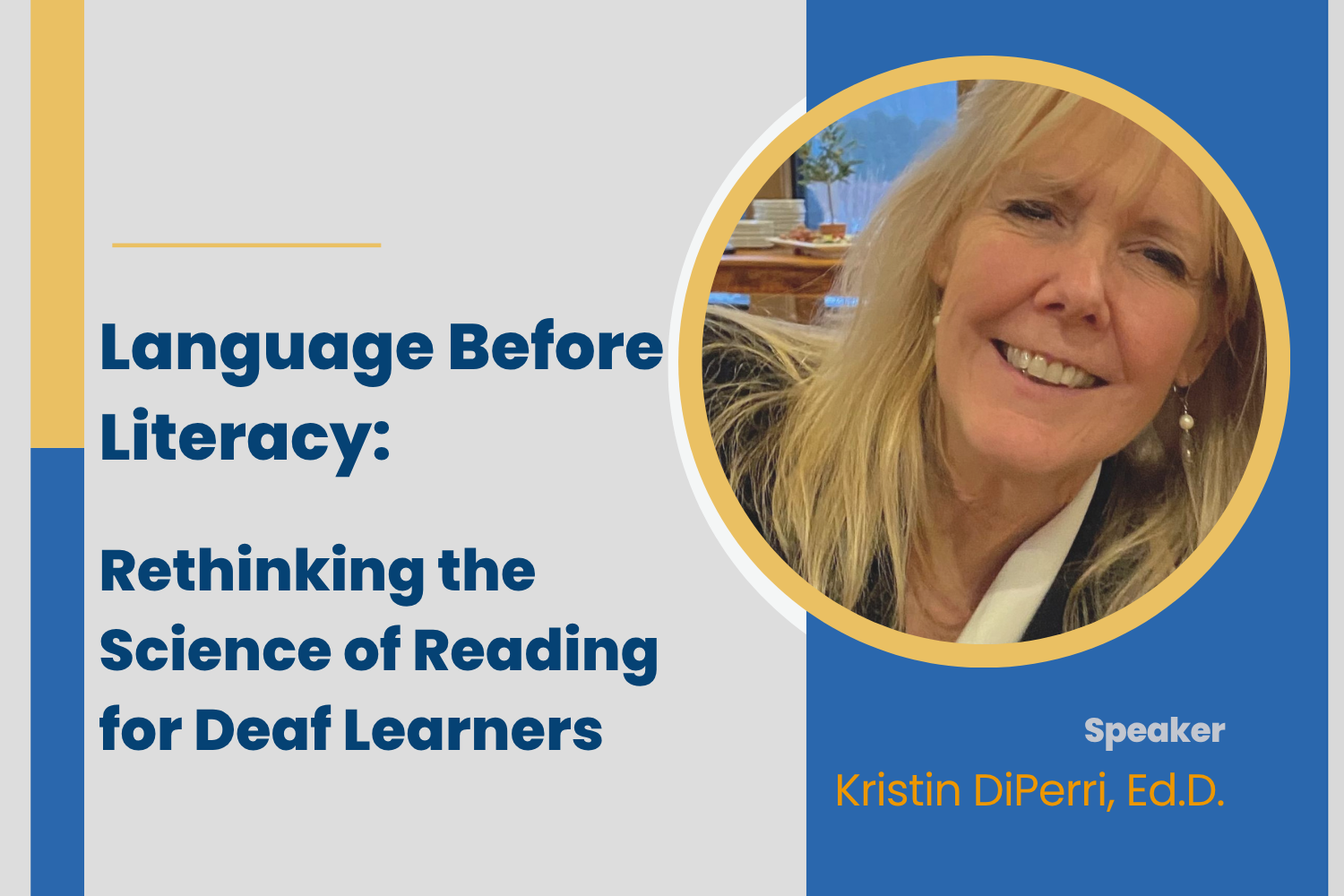
This keynote examines the linguistic realities of deaf learners and explores how sound-based literacy mandates can unintentionally widen achievement gaps. Participants will explore research on language deprivation, alternative pathways to literacy, and visually grounded instructional approaches that honor how deaf children actually acquire language. The session challenges the notion of “one-size-fits-all” reading science and calls for language-first, access-centered literacy policies that ensure equity rather than compliance.

Presenter Bio:

Kristin DiPerri, Ed.D. is an independent educational consultant and literacy development specialist for Deaf and Hard of Hearing students. She has presented numerous workshops and presentations throughout the US and abroad to teachers of Deaf and Hard of Hearing students. For over 40 years she has worked as a classroom teacher, a researcher, an instructor in the Deaf Education program at Boston University and as the English Literacy Coordinator at a residential school for the deaf. She consults with several schools/programs in the US and internationally to implement new literacy programming approaches to meet the diverse literacy needs of DHH students. She is the author of several instructional publications: 5 workbooks for students, the Bedrock Literacy Curriculum and co-author with Todd Czubek, Ph.D. on the Bilingual Grammar Curriculum (www.bgcasl.org). She is the owner of Bedrock Literacy & Educational Services (www.bedrockliteracy.com). She is the co-owner of the Bilingual Grammar Curriculum, LLC (www.bgcasl.org)  with Todd Czubek, Ph.D.

Presentations

Accessible Educational Material in ASL

Presenter: Cara Wilmot – NTID Regional STEM Center

Access to Accessible Educational Materials (AEM) is an integral part of ensuring a free and appropriate public education (FAPE) under the Individuals with Disabilities Education Act (IDEA). For students who are deaf and hard of hearing and use American Sign Language (ASL), traditional print and captioning often fall short in providing full and equitable access. American Sign Language videotext—signed content captured on video—serves as a bridge between written English and visual language. It allows instructional materials to be presented in a format that is linguistically and cognitively accessible to ASL users.

In this interactive session, participants will explore how AEM in ASL can transform access and equity in K–12 education. We will examine the laws, rules, and statutes guiding the provision of AEM, clarify school district responsibilities, and identify practical tools and resources for implementing ASL videotext in classrooms. Participants will also learn how to advocate for AEM in ASL as part of their district’s compliance and inclusive practices. Whether you are an educator, interpreter, or administrator, you will leave with actionable strategies to integrate AEM in ASL across core and elective content areas to support language access, literacy development, and learner independence.


Barnyard Friends: A Language Rich Animal Adventure

Presenter: Mary Ann Stefko – Choices for Children

Did you ever consider spending some time with a goat, a sheep, a dog (or two) and even birds as a way to expand and develop language in Deaf, Hard of Hearing and Deafblind children? At the Scranton School for Deaf and Hard of Hearing Children, our Barnyard Friends program offers students and their families an opportunity to do just that! This unique, Saturday morning experience is a time for families to come together and learn. Children learn about the animals, develop spoken language, sign language and social skills - all in the presence of animals and supported by their families. Led by school staff, the program supports parents and caregivers in learning sign language and coaches them to continue discussing their "adventure" at home - building language and communication skills with their children. We also enlist the help of community partners who share their time and experiences to make learning fun for our students. In Deaf education, we know it takes a village! In Northeast PA, we are excited that our village includes some amazing four legged friends!

Films by Sally Is Sarah Productions - Reimagining Access

Presenter: Sarah Michaelson – Sally is Sarah Productions

What if learning to read were fun? What if you became so immersed in a story, through beautiful ASL signing and animated illustrations, that you didn’t even realize that you were learning at all, you just wanted to know what happened next? What if you were able to enjoy these storybook films in a mixed audience of Deaf, hard of hearing and hearing viewers, each of you feeling fully welcomed?

Our presentation takes you along on a tour of this journey, deep-diving into the films produced by Sally Is Sarah Productions (SISP), a company founded on the idea that stories bring us together. We celebrate each person's uniqueness and understand that our differences are just as valuable as our similarities. Our films feature Deaf actors presenting the stories of inspiring characters who, despite the obstacles they encounter, find a way to chart their own paths. Our aim is to reach, educate and showcase people with all types of abilities, backgrounds and experiences.

As one educator told reflected, “I have tears in my eyes thinking of the validation and acceptance this story brings to people who watch it. You are bringing wonderful stories to life for all children.” Come see for yourself! Everyone is welcome here.

Literacy in the Early Years

Presenter: Natalie Jones - South Carolina School for the Deaf and the Blind

What does literacy development look like in the first three years of life? This presentation will explore the connections between early childhood development and the five areas identified by the National Reading Panel (2000) as critical to a successful reading program: phonemic awareness, phonics, vocabulary, fluency, and comprehension. Strategies to promote development in each of these areas will also be shared.
Multi-modal Language Acquisition

Presenter: Cindy Camp – Described and Captioned Media Program

Communication is an essential life skill. Good communication is the key to successful relationships and work life. However, many individuals who are deaf and hard of hearing lack good communication because they do not have a strong foundation in a primary language.

Historically, there has been a debate over which mode of communication provides deaf children with the best way to learn language. But why should they be limited to just one? Hearing children often grow up bilingual or more. They may learn to speak one language in the home, another in the community, and perhaps a third in school. A child’s mind is amazingly adaptive at learning languages. Deaf children who are provided with visual and spoken language are able to benefit from both.

This presentation will look at resources for providing deaf children with access to sign language, spoken language, and text. By using a combination of all three in the home and classroom, children can increase their vocabulary, improve reading comprehension, and enhance their overall communication abilities.

Representation Matters: Picture Books for Deaf and Hard of Hearing Children

Presenter: Maddie Hinkle – Chicago Hearing Society

This presentation discusses the importance of providing Deaf and Hard of Hearing children with literature in which they can see themselves represented. We explore the options currently available for DHH representational picture books and then discuss more in-depth 24 books or series in five categories based on topic. The categories are: Deaf Life, Hearing Technology, Educational, Inspirational, and Storybook. We will discuss these categories, what kinds of narratives are present in each, and what they are teaching children about themselves and the world around them. We will address techniques in how to read with DHH children and end with a brief discussion of the gaps in existing literature and what families and professionals can do to help fill those gaps.

Adapting books for student’s who are Deaf/HOH with neurological visual impairment (CVI)

Presenter: Rebecca Hommer – Connections Beyond Sight & Sound

Students with dual sensory loss require specialized modifications/adaptations to ensure access to literacy materials and activities. This presentation will provide insights and examples for modifying literacy materials for students who are DeafBlind with CVI.
Beyond the Page: Creating Literacy Access through Wordless Picture Books

Presenter: Adrienne King – McDaniel College

For many DHH and DeafBlind students, the challenge of decoding English print can overshadow their academic ability. When a student’s progress is measured solely by their reading level, they miss opportunities to engage with grade-level curricular concepts. Wordless books change this dynamic by removing the text and providing immediate access to the core work of literacy: analyzing characters, making inferences, and building a story. This 45-minute session offers a practical roadmap for using visual and tactile stories to bridge the literacy gap. We begin with Dignity-First Reading, focusing on sophisticated, age-appropriate visual novels that respect the maturity of older students. We then demonstrate the Picture-to-Print Bridge, a step-by-step method to transition students from visual storytelling in their primary language to written English. Finally, we explore Inclusive Extensions, featuring high-impact strategies for adapting visual narratives for students with dual-sensory loss using concrete objects and tactile anchors. Attendees will leave with a curated "Dignity-First" book list and a toolkit of strategies to ensure every student—regardless of reading or sensory level—is included in high-level classroom discussions.


From Behavior to Language: Building Receptive Foundations for Deaf and DeafBlind Learners

Presenter: Adrienne King – McDaniel College

Every child starts out communicating through behavior such as crying, smiling, and movement to express internal needs. For children who are Deaf, Hard of Hearing, or DeafBlind, the transition from these reflexive behaviors to intentional language is a unique challenge. When sensory access is fragmented, children often rely longer on non-traditional communication. Our job as parents and educators is to bridge this gap by providing the consistent, accessible input a child needs to make sense of their surroundings. Drawing on evidence-based strategies, this session explores the critical receptive phase of development. We will shift the focus from what the child must do to what we, as communication partners, can provide. Using tools like the Communication Matrix and the Literacy Skills Checklist, we will identify how to shape behaviors into intentional communication and eventually functional language. Participants will learn to implement a hierarchy of receptive input including touch cues, real object cues, and tactile signs to create a world that is predictable and meaningful. This session offers practical strategies for those supporting children with language delays, moving from simple connection to a lifelong foundation for literacy.

Reading, Language, and Identity: Lessons from STEM Academy for d/Dhh Students

Presenter: Cara Wilmot - NTID Regional STEM Center

This presentation shares effective reading and language arts practices from the summer STEM Academy hosted by the National Technical Institute for the Deaf Regional STEM Center (NRSC) at the Alabama Institute for the Deaf and Blind. STEM Academy is a federally funded program serving d/Dhh students from 12 southeastern states. Since its launch in 2021, program data show that students consistently demonstrate growth in reading and English Language Arts (ELA) across cohorts.

The session highlights five instructional strategies that have supported strong engagement and steady ELA development while also exposing students to STEM content and addressing the Expanded Core Curriculum through seamless cross-curricular planning: (1) using IXL Learning for daily, data-driven progress monitoring and flexible grouping; (2) teaching reading fluency as explicit instruction rather than assessment alone; (3) incorporating culturally sustaining articles featuring d/Dhh individuals; (4) using online resources and AI tools to adjust text complexity so materials align with students’ instructional and independent reading levels; and (5) integrating student writing projects that connect reading, language, and self-expression.

Participants will learn how these strategies are implemented in small-group settings using flexible instructional arrangements by co-teachers of the deaf and hard of hearing (TODHHs), and how instructional decisions are adjusted in real time using student data. The presentation will also describe how NRSC @ AIDB uses lessons from STEM Academy to provide customized ELA professional learning and follow-up coaching for TODHHs across the Southeast at no cost, supporting sustainable reading and language arts instruction beyond summer programs.

Supporting Early Literacy with Emerging ASL Skills Practical Strategies for Sharing Any Book and Any Story

Presenter: Gina Freelove – About Love and Language

Reading to young children is generally regarded as a fundamental component of early childhood development. According to the American Academy of Pediatrics, “Reading regularly with young children stimulates optimal patterns of brain development and strengthens parent-child relationships at a critical time in child development, which, in turn, builds language, literacy, and social-emotional skills that last a lifetime.”

Since 90% of deaf children are born to hearing parents with little to no experience with hearing loss, sharing books can present unique challenges!

This presentation provides valuable tips and strategies for sharing any book or story, even with limited ASL skills! The suggestions are compiled from guidance provided by the AAP and the Clerc National Center for Deaf Research, offering practical methods and introducing resources to assist parents and professionals in nurturing early language and literacy among DHH children.


ASL Rhymes A Bridge We Didn’t Know Our Hard of Hearing Child Needed

Presenter: Laura Blum – About Love and Language

The human brain is captivated by repetitive patterns. Hearing children are immersed daily with nursery rhymes, children's songs, video programs and books, yet Deaf children cannot fully access or benefit from spoken rhymes. Rhymes are language specific and are often lost when translated in American Sign Language. Tabitha H. shares, “My daughter is HOH. Introducing ASL rhymes was a bridge we didn’t know she needed until it was presented to her. The ability to connect handshapes with words has opened her access to language and truly aided her in her bilingual journey.”

Roll up your sleeves and get ready to learn how to create ASL rhymes and incorporate more ASL rhymes in home and school settings- even with emerging ASL skills!

"Don't Forget the FUN!"

Presenter: Mary Ann Stefko - Choices for Children

Families who begin their hearing loss journey with a newly identified infant or toddler are often overwhelmed with appointments, meetings and therapy. While these are important, it equally important to remember that they are celebrating the addition of a new family member. A time for hope and joy and FUN! Let's take a look at some of those family activities that can become powerful language learning moments - a trip to the car wash, a visit to the park, even sorting the laundry! Daily activities, including a variety of family members and friends, can be FUN and exciting opportunities to build and share language with your Deaf/Hard of Hearing child.

Literacy as an Multisensory Experience

Presenter: Ann Pimentel – Provincial Outreach Program

What if literacy was fully felt and experienced through many senses to enhance learning and belonging? This presentation shares preliminary findings from an action research project that explores how tactile literacy and immersive storytelling can support communication, life skills, choice-making, and meaningful literacy engagement for a Grade 12 student with deafblindness and her classmates with complex learning needs.

Grounded in inclusive and strengths-based practice, we have expanded the literacy curriculum through an individualized tactile calendar and an immersive, multisensory, novel study. We have implemented a variety of approaches designed to engage students through touch, movement, sound, scent, and real-world experiences. Tactile cues, real-life objects, interactive toolbox, and experiential elements are embedded within the student’s literacy program, transforming the novel into a lived and shared experience. This approach positions literacy as relational, allowing students to anticipate events, make choices, express preferences, and participate meaningfully alongside peers.

This project demonstrates how expressive and receptive communication, through tactile and immersive literacy, can enrich peer relationships, and deepen inclusive classroom practice. It illustrates how multisensory storytelling can foster belonging, agency, and authentic participation not only for a student with deafblindness, but for the entire learning community.


Reframing Language Deprivation

Presenter: Morgan Lee – Portland Public Schools

Language deprivation is the lack of language exposure during a child’s age of acquisition which impacts language development, academic success, and cognitive capabilities. Children from marginalized communities are more likely to suffer from language deprivation and less likely to have instructors who share their cultural background. Transformative classrooms require staff to understand their own positionalities and recognize the intersectionalities of their students. To create these spaces, teachers must take a balcony approach to recognize systemic barriers, biases, and deficit thinking that can negatively affect their students. A culturally responsive classroom can be built using approaches that honor each student. Doctoral research centering the lived experiences and recommendations of BIPOC Deaf practitioners of the Deaf anchor this presentation through a critical framework.


The Keys to Your Playhouse

Presenter: Becca Fogg – Florida Hands & Voices

During this interactive session, participants will learn about the significant impact of play on language acquisition. Session facilitators will share simple approaches through guided, hands-on gameplay from their combined perspectives. This professional-parental collaboration will provide the audience with practical strategies for leading inclusive, language-rich games that support DHH children in developing stronger communication skills. This session will highlight how play is more than just fun—it is an essential bridge to language growth and cognitive development.

Play is a powerful tool for language development, but traditional childhood games often lack the accessibility needed for Deaf and Hard of Hearing (DHH) children to fully engage and benefit from them. The Playbook reimagines classic games like Red Light, Green Light, Hide and Seek, and dream telling with thoughtful accommodations that ensure every child can participate while building essential language skills. By integrating visual, tactile, and linguistic adaptations, these games create rich opportunities for vocabulary expansion, sentence formation, and social communication—key components of cognitive development.