Finding connection, encouragement, and community along your family’s journey
You Don’t Have to Do This Alone
Every family needs support. Sometimes that support comes from the people who have always been part of our lives. Other times, it comes from new connections we make as our children grow, learn, and experience the world.
For families raising deaf or hard-of-hearing children, the journey may introduce new people, experiences, opportunities, and questions. You might find yourself learning about communication approaches, exploring educational options, navigating services, or advocating for your child’s needs. Along the way, you may encounter moments of uncertainty, unexpected challenges, exciting milestones, and accomplishments worth celebrating.
Having people around you who can share those experiences, offer encouragement, provide information, or simply listen can make a meaningful difference.
This is your circle of support—the people, relationships, and resources you can turn to throughout your family’s journey.
Your circle doesn’t have to be large, and it certainly doesn’t have to look like anyone else’s. Some families have a wide network of relatives, friends, professionals, and community connections. Others rely on a few trusted people who play important roles in their lives.
What matters isn’t the number of people in your circle. It’s knowing that you have people you can turn to and recognizing that you don’t have to figure everything out on your own.
Support Looks Different for Every Family
When we think about a support network, we often picture the people who help us solve problems or answer questions, but support can take many forms, and different people may offer different kinds of encouragement and assistance.
Sometimes what we need most is someone who will listen.
It might be a friend who lets you talk through a difficult decision, a grandparent who checks in after an important appointment, or a partner who understands when you need a moment to sort through your thoughts. These relationships provide space to share feelings, celebrate successes, and talk openly without expecting someone to have all the answers.
Other times, support is practical.
A family member who helps with transportation, a neightbor who watches a sibling during a meeting, or a friend who offers to help organize information can make an overwhelming week feel more manageable. These everyday acts of kindness may seem small, but they can have a lasting impact.
And sometimes, the most meaningful support comes from someone who understands an experience because they’ve lived it.
Connecting with other parents raising deaf or hard-of-hearing children can create opportunities to share stories, ask questions, exchange ideas, and learn from one another. A parent who has navigated a similar school transition or language and communication experiences may offer a perspective that is difficult to find elsewhere.
Deaf and hard-of-hearing adults can also bring valuable experiences and perspectives to a family’s circle. They may share insights about language, identity, education, relationships, community, and the many possibilities available to deaf and hard-of-hearing children as they grow.
These connections can help families see beyond immediate questions and imagine the opportunities ahead.
The people who listen, the people who help, and the people who understand each contribute something different. No single person needs to meet every need.
The Role of Professionals and Community Resources
As children grow, families often develop relationships with a variety of professionals. Depending on a child’s age and individual needs, these might include early intervention providers, audiologists, teachers, interpreters, medical professionals, educational specialists, service coordinators, or other support providers.
These individuals can offer expertise, explain available services, help families understand options, and provide guidance during important decisions.
Strong relationships with professionals are built through communication, mutual respect, and shared goals. Families should feel comfortable asking questions, sharing observations, expressing concerns, and participating actively in decisions affecting their children.
It’s also important to remember that professional support is only one part of a family’s larger network.
Parents and caregivers bring an understanding of their child’s personality, interests, strengths, experiences, and everyday life that no professional can replace. Their knowledge and perspectives are essential.
Professionals may be part of your circle of support, but your child and family remain at its center.
Community organizations can also play an important role. Family support programs, Deaf community organizations, parent networks, advocacy groups, and educational organizations may offer opportunities to connect with othes, participate in activities, access resources, or develop new skills.
These connections can be especially valuable when families are looking for information or experiences beyond their immediate community.
Your Circle Will Grow and Change
The support a family needs when a child is an infant may look very different from what is helpful during elementary school, adolescence or the transition to adulthood.
During the early years, families may rely heavily on early intervention providers, other parents of young children, and people who can help them explore communication and language development.
As children enter school, teachers, educational teams, other families, and community programs may become increasingly important. Parents may find themselves seeking connections with people who understand school experiences, friendships, extracurricular activities, or educational planning.
During adolescence and young adulthood, families may begin building relationships with mentors, transition specialists, vocational programs, adult service providers, and community organizations that support increasing independence.
And throughout all these stages, relationships with Deaf and hard-of-hearing peers and adults can offer important opportunities for connection, belonging, and shared experiences.
Some people will remain part of your circle for many years. Others may become important during a particular season of life.
There is nothing wrong with a circle that changes. In fact, that is exactly what a healthy support network often does.
It grows alongside your family.
Making Connections Takes Time
Building a circle of support doesn’t always heppen naturally or easily.
Some families live far from Deaf community organizations or other families raising deaf or hard-of-hearing children. Others may have limited transportation, busy schedules, language barriers, or simply feel unsure about where to begin.
Sometimes, asking for help can be difficult. We may feel that we should already know the answers or that we need to manage everything ourselves.
But reaching out for support is not a sign that something is missing from your family. It is a way of creating opportunities for connection, learning, and shared experiences.
Building your circle might begin with a simple conversation.
You could ask a professional whether they know of a parent group, attend a family event, explore a local Deaf community organization, or connect with another family online. You might invite a relative to learn ASL with you or reach out to someone who has offered help in the past.
Not every connection will become a lasting relationship, and that’s okay.
The goal isn’t to collect contacts or build the largest possible network. It’s to find people and communities where your family feels welcomed, respected, and supported.
A Circle That Includes Your Child
As children grow, their own relationships become an increasingly important part of the circle.
Friendships, connections with Deaf and hard-of-hearing peers, relationships with trusted adults, and opportunities to participate in community activities can all contribute to a child’s sense of belonging.
Children benefit from having people in their lives who communicate with them directly, include them in conversations and activities, respect their communication needs, and recognize their strengths.
A meaningful circle of support isn’t only about the adults helping parents navigate decisions. It’s also about creating a community where children can build relationships, develop confidence, explore their identities, and participate fully.
As children become older, they can take a more active role in identifying the people they trust, the relationships they value, and the kinds of support they find helpful.
Their voices and preferences deserve a place in the conversation.
Take a Look at Your Own Circle
You may already have more support around you than you realize.
Think about the people you turn to when you have a question, need encouragement, want to celebrate something, or could use an extra hand.
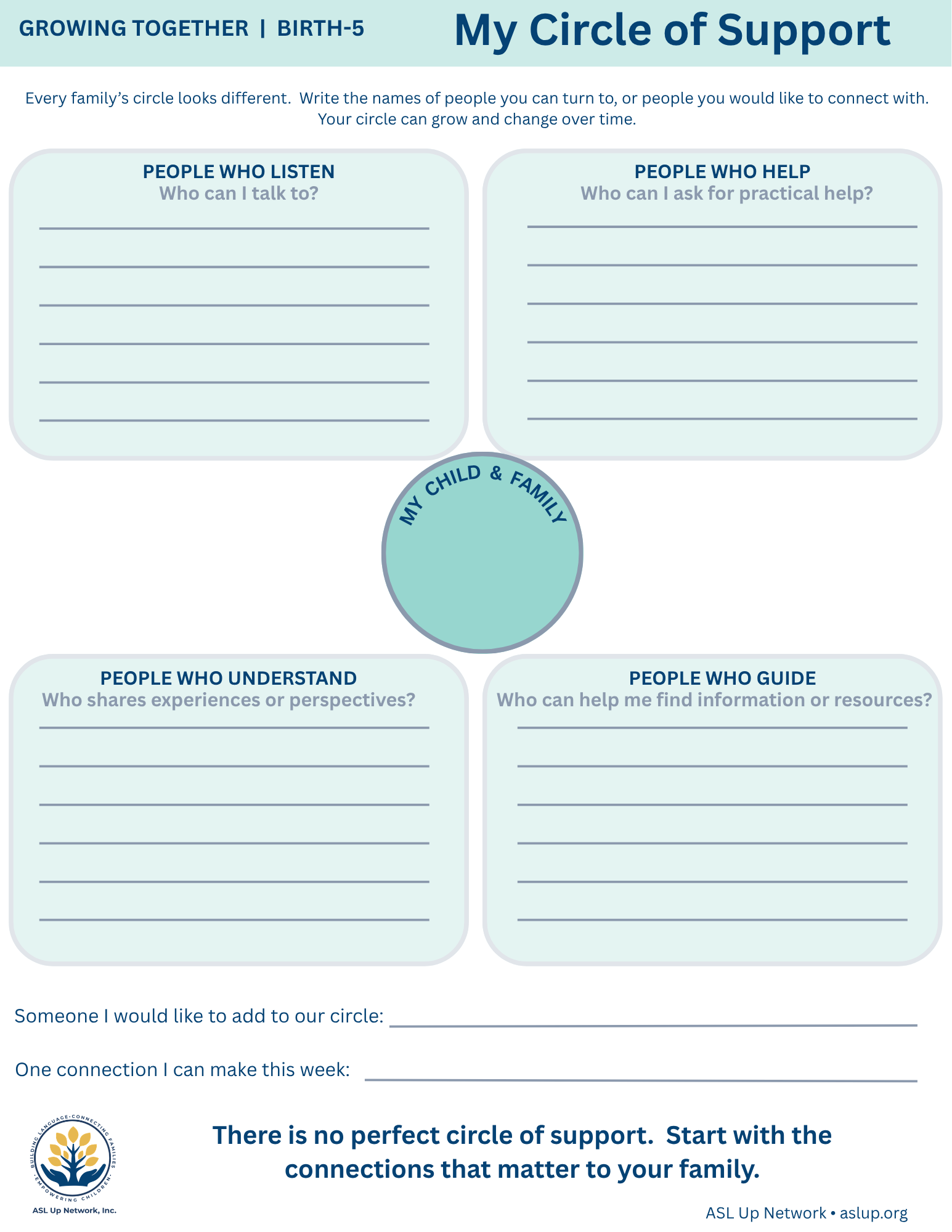
Who listens when you need to talk? Who helps when everyday responsibilities become overwhelming? Who understands some of your family’s experiences? Who provides information or guidance when you need it?
Now think about the connections you might like to strengthen or develop.
Perhaps you would like to meet another family, connect with a Deaf adult mentor, become involved in a community organization, or help your child develop friendships with other deaf and hard-of-hearing children.
You don’t have to make all those connections at once.
Start with one.
Put It Into Practice: My Circle of Support
Our My Circle of Support printable is designed to help families identify the people and resources already in their lives while considering connections they might like to make.
Use it together as a family, revisit it as your child grows, and remember that there is no right or wrong way to build your circle.
Growing Together, Staying Connected
Every family’s journey is different, and no one has all the answers.
The people who walk alongside us can offer encouragement, share knowledge, open doors to new opportunities, and remind us that we are part of something larger than ourselves.
Some connections last a lifetime. Others help us through a particular moment. Both can be meaningful.
Your circle of support doesn’t need to be perfect or complete. It simply needs room to grow—with your child, your family, and the relationships that matter most.